
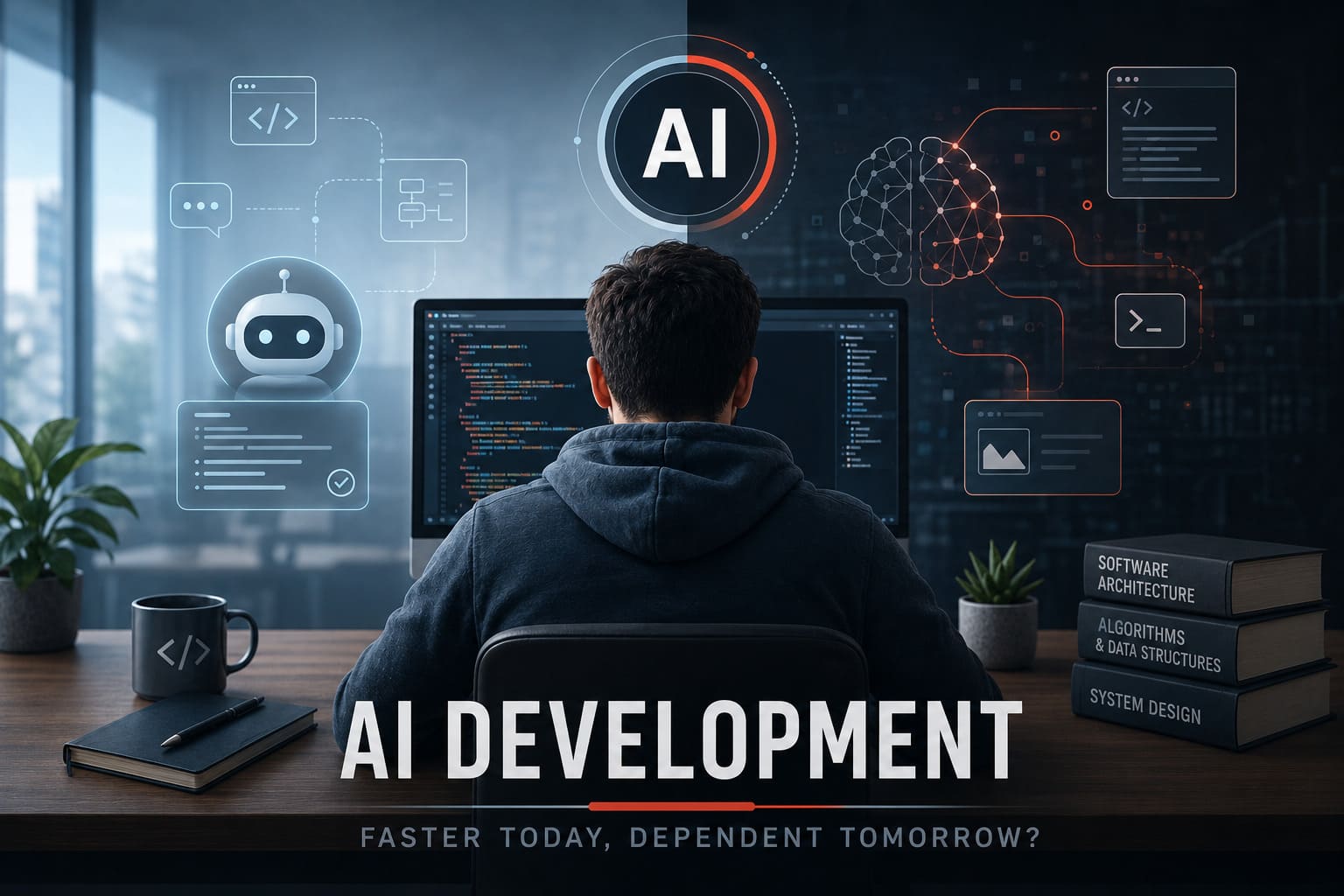
AI Development: Pros and Cons: Is AI Creating Better Developers or Making Them Dependent?
Author: Rostyslav Wirt
Table of content:
- Artificial Intelligence Has Changed Software Development Forever
- The Greatest Benefit: Software Development Has Never Been Faster
- The Hidden Cost Nobody Is Talking About
- What Happens When Developers Stop Practicing?
- Developers Are Becoming AI Managers Instead of Software Engineers
- The Risk of Becoming Dependent on AI
- +11 Show all
Artificial Intelligence Has Changed Software Development Forever
Just a few years ago, writing software meant spending hours reading documentation, searching Stack Overflow, debugging mysterious errors, and experimenting until something finally worked. Every developer, regardless of experience, followed roughly the same learning path: write code, make mistakes, fix them, repeat. It was often frustrating, but that repetition gradually built intuition, confidence, and deep technical knowledge.
Today, the development workflow looks very different. Modern AI assistants like ChatGPT, Claude Code, Cursor, GitHub Copilot, and Gemini have fundamentally changed how software is built. Instead of manually implementing every function or searching through dozens of documentation pages, developers can describe what they want in plain English and receive production-ready code within seconds.
Need a Laravel API endpoint? AI can generate it. Need a React component? AI can build it. Need a complex SQL query or a regular expression? AI usually has an answer before you’ve finished typing the question. For many developers, it feels almost magical. Tasks that once consumed an entire afternoon can now be completed during a coffee break. Startups launch products faster than ever. Freelancers deliver projects more quickly. Agencies increase their margins by reducing development time, while companies can ship new features at a pace that would have seemed impossible only a few years ago.
There’s no question that artificial intelligence has become one of the most significant productivity tools ever introduced to software engineering. But every revolutionary technology changes more than just productivity. It changes the people who use it. And that’s where the conversation becomes far more interesting. Most discussions about AI focus on what these tools can do today. They compare models, benchmark coding performance, or debate which assistant generates the cleanest code. Far fewer people ask a much more important question:
What happens to developers after relying on AI every single day for five or ten years?
The answer isn’t obvious because we’re only at the beginning of this transition. However, history suggests that every technology that automates part of our work also changes the skills we practice—and the skills we gradually lose. Artificial intelligence is unlikely to be an exception.
The Greatest Benefit: Software Development Has Never Been Faster
If we’re going to discuss the risks of AI-assisted development, we should first acknowledge something important:
AI genuinely works.
This isn’t another overhyped productivity trend destined to disappear in a year. AI has already become part of the daily workflow for millions of developers, and for good reason.
A modern coding assistant can generate boilerplate code, explain unfamiliar libraries, write unit tests, optimize SQL queries, detect bugs, review pull requests, summarize documentation, create API integrations, and even suggest architectural improvements. Instead of switching between documentation, Stack Overflow, GitHub issues, and multiple browser tabs, developers can often receive a useful answer almost instantly.
The productivity gains are difficult to ignore.
Imagine building a new feature from scratch. Ten years ago, you would spend hours searching for examples, comparing different approaches, reading official documentation, and debugging implementation details. Today, AI can provide a solid starting point within seconds, allowing you to focus on refining the solution rather than building everything from the ground up.
For experienced engineers, this means less time spent on repetitive coding and more time thinking about architecture, scalability, security, and business logic.
For junior developers, AI acts almost like a personal mentor available twenty-four hours a day. It explains concepts, reviews code, answers questions, and provides examples without the fear of asking “stupid questions.”
Even businesses benefit enormously. Projects are delivered faster. Development costs decrease. Teams become more productive without necessarily becoming larger. Startups can validate ideas more quickly, and agencies can handle more client work with the same number of engineers. In many ways, AI is doing exactly what every great development tool has always aimed to do: eliminate repetitive work so developers can focus on solving meaningful problems. Viewed from this perspective, AI isn’t replacing developers. It’s amplifying them. At least, that’s the short-term picture.
The Hidden Cost Nobody Is Talking About
The problem isn’t that AI writes code. The problem is that developers write less code themselves. At first glance, that might not sound like an issue. After all, software engineering has always evolved through better tools. We no longer write machine code, manage memory manually for every application, or build user interfaces pixel by pixel. Frameworks, libraries, and high-level programming languages all made development easier without making developers less capable.
So why should AI be different?
The difference is that previous tools automated repetitive tasks. AI automates thinking itself. Instead of asking you to solve a problem, AI often solves the problem before you’ve fully considered it. That’s an enormous shift. Programming has never been just about producing code. It’s about developing a way of thinking—breaking complex problems into smaller pieces, recognizing patterns, evaluating trade-offs, and gradually building intuition through practice.
Those skills don’t develop by reading AI-generated answers. They develop by struggling. Every experienced developer remembers spending hours debugging something that eventually turned out to be a missing semicolon, an incorrect variable name, or an unexpected edge case. Those moments were frustrating, but they permanently changed how we approached future problems. The struggle wasn’t wasted time. It was training. If AI removes too much of that training, developers may become more productive while simultaneously becoming less practiced. That’s a subtle distinction, but an important one.
What Happens When Developers Stop Practicing?
Every skill depends on repetition. A professional pianist practices scales despite already knowing how to play. Athletes continue training even after winning championships. Pilots spend hours in simulators long after receiving their licenses. Programming is no different.
The reason senior developers can solve complex problems so quickly isn’t because they memorized every programming language. It’s because they’ve written thousands of functions, debugged countless production issues, refactored messy codebases, and learned from years of trial and error.
That repetition creates instinct. You no longer think about syntax. You don’t consciously remember every function. Your brain simply knows what comes next. But what happens if AI writes most of your code for the next decade?
Imagine asking AI to generate every loop, every SQL query, every API endpoint, every validation rule, every regular expression, and every recursive function. Initially, nothing seems wrong. In fact, everything feels faster. Then, months later, you open a blank file without AI assistance. Suddenly, simple things require more thought than they used to. You hesitate over syntax that once came naturally. You search documentation for methods you previously remembered by heart. Algorithmic thinking feels slightly slower. Problem-solving becomes less intuitive. This isn’t because you’ve become a worse developer. It’s because your brain adapts to the habits you reinforce.
Neuroscience has shown that repeated practice strengthens neural pathways, while neglected skills gradually weaken over time. Programming is no exception. The less often you actively solve problems yourself, the less automatic those solutions become. That’s why one of the biggest long-term risks of AI isn’t job displacement. It’s skill atrophy. Developers won’t suddenly forget how to program overnight. Instead, they’ll slowly transition from builders into reviewers—people who evaluate AI-generated code instead of creating it themselves. That transformation may be so gradual that many won’t notice it until they find themselves coding without AI for the first time in years.
Developers Are Becoming AI Managers Instead of Software Engineers
One of the most fascinating changes AI has introduced isn’t technical—it’s psychological. Ask an experienced developer how they spent a typical day five years ago, and the answer would probably include writing new features, debugging issues, refactoring old code, and implementing business logic. Ask that same developer today, and the answer often sounds very different.
Instead of writing code from scratch, they spend much of their day explaining problems to AI, reviewing generated solutions, fixing edge cases, and breaking large features into smaller prompts. In many ways, the keyboard has become less important than the prompt. This shift is subtle but significant.
Developers are gradually moving away from implementation and toward orchestration. Rather than acting as builders, they’re becoming directors—deciding what should be built while AI handles much of the how. That isn’t necessarily a negative change. Software engineering has always evolved. We moved from assembly language to C, from C to modern frameworks, and from manually configuring servers to cloud platforms. Each technological leap allowed developers to work at a higher level of abstraction.
The difference is that previous tools still required developers to solve problems themselves. AI increasingly solves those problems before the developer has fully explored them. The role begins to resemble that of a technical lead or project manager. Success depends less on typing code quickly and more on defining requirements clearly, understanding business objectives, validating AI-generated output, and making architectural decisions.
Ironically, communication skills may become just as valuable as programming skills. The developers who thrive in this new era won’t necessarily be those who write the fastest code. They’ll be the ones who ask the best questions, provide the clearest instructions, and recognize when AI is confidently producing the wrong answer. That may redefine what it means to be a software engineer over the next decade.
The Risk of Becoming Dependent on AI
Every powerful tool creates dependency. We rarely memorize phone numbers anymore because smartphones remember them for us. GPS navigation has made traveling easier, but it has also weakened many people’s natural sense of direction. Search engines have changed how we remember information because we know we can always look it up later.
AI is creating a similar dependency for developers. At first, it feels harmless. Why spend twenty minutes writing a regular expression when AI can generate one in five seconds? Why manually debug a complicated SQL query when an assistant immediately points out the problem? Why read fifty pages of documentation if AI summarizes everything instantly? Each individual shortcut makes perfect sense. The danger appears only after thousands of these shortcuts accumulate.
Imagine a developer who has relied on AI every working day for the next five years. Then imagine their internet connection fails during an important production incident, or their company temporarily loses access to AI tools due to security policies. Would they remain equally productive? Most developers confidently answer yes. I’m not entirely convinced. Habits shape our abilities more than we realize. If AI becomes responsible for syntax, debugging, documentation, and implementation, our own problem-solving muscles inevitably receive less exercise. Dependency rarely arrives suddenly. It grows so gradually that it feels completely normal. That’s exactly what makes it dangerous.
AI Is Free Today. Will It Stay That Way?
Another question receives surprisingly little attention. Who ultimately profits from AI-powered software development? Today, developers happily pay twenty or thirty dollars per month for AI assistants because the return on investment is obvious. Saving even one hour each week easily justifies the subscription cost. But we’re still in the early stages of the AI economy.
Training and operating modern language models costs billions of dollars. Companies invest enormous amounts in GPUs, electricity, networking infrastructure, data centers, engineering teams, and research. Eventually, those investments need to generate sustainable profits. As developers become increasingly dependent on AI, pricing power shifts toward AI providers. Think about what happened with cloud computing.
Companies initially viewed cloud services as inexpensive alternatives to managing physical servers. Years later, many organizations discovered they had become deeply dependent on cloud platforms, making migration expensive and difficult. The same scenario could emerge with AI. If every development workflow depends on AI assistance, subscription prices may gradually increase—not because providers are greedy, but because customers have few realistic alternatives.
Developers may find themselves in a position where AI becomes as essential as an IDE or internet connection. Once that happens, software companies won’t simply be paying developers. They’ll also be paying AI companies for every developer they employ. That fundamentally changes the economics of software engineering.
Why Developer Salaries May Face Increasing Pressure
Artificial intelligence doesn’t have to replace developers to change the job market. It only needs to make each developer significantly more productive. Imagine a company that previously required six engineers to maintain its product. If AI enables four engineers to accomplish the same amount of work, the business suddenly has difficult financial decisions to make. Should it continue employing six people? Or reduce the team and lower costs? History suggests that businesses usually choose efficiency. This doesn’t necessarily mean mass unemployment.
Software demand continues to grow, and AI will undoubtedly create entirely new categories of work. However, it does mean the balance between supply and demand is changing. Companies will expect engineers to produce more than ever before. The productivity gains created by AI quickly become the new standard rather than a competitive advantage.
Yesterday, shipping a feature in two weeks was impressive. Tomorrow, the same feature may be expected in three days. As expectations rise, individual developers may feel increasing pressure to deliver larger amounts of work without equivalent increases in compensation. In other words, AI doesn’t automatically reduce the value of software. It may reduce the value of routine software development. The engineers who simply implement specifications may become easier to replace.
Those who understand products, business strategy, system architecture, scalability, security, and customer needs will likely remain in high demand. The market has always rewarded people who solve difficult problems. AI simply raises the definition of what qualifies as “difficult.”
Junior Developers Face the Biggest Challenge
Artificial intelligence is often described as the best mentor a junior developer could have. In many ways, that’s true. It can explain unfamiliar concepts, review code, suggest improvements, and answer questions instantly without judgment. Someone learning Laravel, React, or Python today has access to resources that simply didn’t exist a few years ago. The problem is that learning and understanding are not the same thing.
Anyone can ask AI to build a REST API, generate database migrations, or implement authentication. The code will probably work. But if the junior developer never struggles with the implementation, they may never fully understand why it works. Every experienced engineer remembers spending hours trying to fix bugs that now seem trivial. At the time, those moments felt frustrating and unproductive. Looking back, they were some of the most valuable lessons in a developer’s career.
There’s a reason senior engineers often say that debugging taught them more than writing code. When AI removes too much of that process, new developers may become productive much faster than previous generations, but they may also develop weaker technical foundations.
This creates a strange paradox. A junior developer using AI might deliver features comparable to someone with several years of experience. Yet if you remove the AI assistant, the gap in knowledge quickly becomes obvious. That doesn’t mean junior developers should avoid AI. Far from it. The challenge is learning to use AI as a teacher rather than a substitute for learning. Asking “Can you explain why this works?” is far more valuable than repeatedly asking “Write this function for me.” The developers who continue to ask questions instead of simply copying answers will build stronger careers over the long term.
What This Means for Outsourcing Countries
The global software industry has been built on one simple idea for decades: companies could hire talented engineers in countries with lower labor costs and still receive excellent results. This model transformed the economies of countries such as Ukraine, Poland, India, Vietnam, Argentina, and many others. Thousands of companies built successful businesses around outsourcing and outstaffing, while millions of developers found well-paid careers serving international clients.
AI has the potential to reshape that model. If one engineer equipped with AI can produce the output that previously required two or three developers, companies naturally begin to question the size of their teams. Cost advantages become less significant when the total amount of development work decreases.
A startup that previously needed ten outsourced developers may discover it can achieve similar results with four highly experienced engineers supported by AI tools. This doesn’t mean outsourcing will disappear. There will always be demand for talented developers who understand business requirements and can build reliable software. However, competition is likely to become much stronger. Simply being an affordable developer may no longer be enough. Companies will increasingly look for engineers who understand products, communicate effectively with stakeholders, make architectural decisions, and take ownership of business outcomes. In other words, technical skills alone may become less of a competitive advantage. Understanding the customer’s business could become just as valuable as understanding the programming language.
Will Frameworks Become AI-First Instead of Developer-First?
Programming frameworks have always evolved to make developers more productive. High-level abstractions, dependency injection, code generation, ORM systems, and component libraries all exist to reduce repetitive work. AI may push this trend much further. Imagine a future where frameworks are designed primarily for AI assistants rather than human developers.
Instead of writing dozens of files manually, developers describe a feature in natural language and the framework generates models, controllers, validation rules, tests, documentation, database migrations, API endpoints, and deployment configuration automatically. At first, this sounds incredibly attractive. Development becomes dramatically faster. Projects become easier to start. Boilerplate almost disappears. But another question emerges. Who is actually reading the code?
If AI generates most of a project’s implementation and AI is also responsible for explaining that implementation, human-readable code becomes less important than machine-readable code. Future applications may consist of thousands of generated files that few developers ever read directly. Instead of opening source files, engineers might simply ask an AI assistant:
“Explain how our payment system works.”
The AI becomes the interface between developers and the codebase itself. That possibility would have sounded absurd only a few years ago. Today, it already feels surprisingly realistic.
The Internet Is Becoming Flooded With AI Content
Software development isn’t the only industry experiencing this transformation. The same thing is happening across the internet. Articles. Images. Videos. Marketing campaigns. Social media posts. Product descriptions. Newsletters. Entire websites can now be generated in minutes. From a business perspective, that’s remarkable. Content production has never been faster or cheaper. From a user’s perspective, the picture is more complicated. When the cost of creating content approaches zero, the amount of content grows exponentially. Unfortunately, human attention does not.
Readers don’t suddenly have ten times more hours available each day simply because AI can produce ten times more articles. The result is what economists would call inflation. Not monetary inflation, but content inflation. When millions of articles are published every day, each individual article becomes less valuable. The internet becomes louder. Finding genuinely useful information becomes harder.
Search engines will likely adapt by placing even greater emphasis on originality, first-hand experience, expertise, and credibility. Ironically, AI may make authentic human knowledge more valuable rather than less. Anyone can generate an article explaining how Redis works. Very few people can write about scaling Redis to millions of requests per second because they’ve actually done it. Experience cannot be generated. It has to be earned. That may become one of the most valuable assets in the AI era.
How Developers Can Stay Relevant in the AI Era
After reading about all these risks, it’s easy to conclude that AI is bad for software development. I don’t believe that’s true. Artificial intelligence is one of the most valuable tools our industry has ever created. It removes repetitive work, accelerates learning, and allows developers to solve problems much faster than ever before. Ignoring AI today would be just as shortsighted as refusing to use Git, Docker, or modern frameworks.
The goal isn’t to avoid AI. The goal is to avoid becoming dependent on it. The difference may seem subtle, but it will define successful developers over the next decade. The engineers who continue growing their skills will treat AI as an assistant, not as a replacement for their own thinking.
That means continuing to write code manually from time to time, even when AI could do it faster. It means solving algorithmic problems without immediately asking for the answer. It means reading documentation instead of relying exclusively on summaries. It means understanding why AI generated a particular solution instead of simply accepting it because “it works.”
Think about professional athletes. Modern sports are filled with technology—performance analytics, heart-rate monitors, motion tracking, nutrition software, and AI-powered coaching. Yet elite athletes still spend thousands of hours practicing the fundamentals. No amount of technology replaces training. Software engineering isn’t any different. The fundamentals remain the fundamentals. Understanding databases. Networking. Operating systems. Memory management. Concurrency. Distributed systems. Security. Software architecture. These subjects don’t become less important because AI writes better code. In many cases, they become more important because someone still needs to recognize when AI is making poor architectural decisions. The developers who understand computer science deeply will always gain more value from AI than those who rely on it blindly.
Perhaps the Most Important Skill Will Be Critical Thinking
One thing AI still cannot replace is judgment. Large language models are incredibly good at generating plausible answers. That’s both their greatest strength and their greatest weakness. Sometimes the generated code is elegant. Sometimes it’s inefficient. Sometimes it’s insecure. Occasionally, it’s completely wrong while sounding absolutely convincing. The more experienced the developer, the easier it is to spot these mistakes. A junior engineer might happily copy AI-generated code into production because it compiles successfully. A senior engineer asks different questions. Will this scale? Is this secure? What happens under heavy load? What if the API changes? Are there hidden edge cases? These questions don’t disappear simply because AI can generate working code. If anything, they become even more important. As software grows increasingly AI-assisted, critical thinking may become the defining characteristic of great engineers. Knowing how to code will still matter. Knowing how to evaluate code may matter even more.
My Prediction for the Next Ten Years
No one knows exactly where AI is taking software engineering. Anyone claiming certainty is probably overestimating their ability to predict the future. Still, several trends already seem likely. AI assistants will become standard tools rather than optional productivity boosters. Development teams will become smaller but more productive. Routine programming tasks will continue to disappear. Frameworks will become increasingly AI-friendly. The barrier to building software will continue to fall. At the same time, competition among developers will increase. Writing code alone will become less valuable because AI can already generate much of it.
Understanding business problems, designing systems, communicating with stakeholders, and making good engineering decisions will become increasingly important. The software engineer of 2035 may spend less time typing and far more time thinking. Ironically, that’s exactly what many experienced developers have always argued software engineering is really about. Not writing code. Solving problems.
AI Is Creating a Generation of “Pseudo-Senior” Developers
One consequence of AI-assisted development that isn’t discussed nearly enough is its effect on how we measure experience. For decades, becoming a senior developer followed a fairly predictable path. You spent years building applications, making mistakes, debugging production issues, refactoring legacy code, and gradually developing intuition. Seniority wasn’t determined by the number of programming languages you knew or the frameworks listed on your résumé—it came from experience. You had already encountered hundreds of problems before, so you could recognize patterns and make better decisions.
AI changes that equation. Today, a developer with only a year or two of experience can produce code that looks remarkably similar to work written by someone with ten years in the industry. With the help of AI, they can generate well-structured APIs, design clean React components, write comprehensive unit tests, and even suggest architectural patterns they may never have used themselves.
From the outside, the difference between a junior and a senior developer becomes much harder to see. But appearance isn’t the same as understanding. The real challenge begins when AI’s suggestions don’t work. Production systems rarely fail in predictable ways. Databases become corrupted. APIs return inconsistent responses. Race conditions appear under heavy traffic. Memory leaks emerge after weeks of uptime. Performance slowly degrades as the user base grows. These are the kinds of problems that AI cannot always solve correctly because they require context, experience, and engineering judgment.
A developer who has spent years debugging real production systems approaches these situations differently from someone whose experience has been largely AI-assisted. The senior engineer doesn’t just ask, “How do I fix this?” They ask, “Why did this happen in the first place?” That difference is enormous.
Over the next few years, companies may find it increasingly difficult to evaluate engineering talent. Traditional coding interviews may become less meaningful when candidates can prepare with AI or when coding itself represents only a small part of the job. Even completed projects and GitHub portfolios may reveal less than they once did, since much of the implementation could have been AI-generated.
As a result, hiring processes are likely to evolve. Employers may place greater emphasis on system design, debugging sessions, architectural discussions, communication skills, and the ability to explain technical decisions rather than simply producing working code. In other words, the industry may begin separating developers who can generate code from engineers who truly understand software systems. That distinction has always existed. AI simply makes it much harder to recognize.
Ironically, artificial intelligence may not reduce the demand for senior engineers at all. Instead, it could increase the value of genuine expertise while making it easier for inexperienced developers to appear more capable than they really are.
The future may belong not to those who can produce the most code, but to those who can consistently make the right technical decisions when there is no obvious answer—and when even AI isn’t sure what to do next.
Final Thoughts
Artificial intelligence is transforming software development at a pace unlike anything our industry has experienced before. For the first time, developers have access to tools that don’t simply automate repetitive tasks—they actively participate in the creative process. That’s extraordinary. It enables individuals to build products that once required entire teams. It lowers the barrier to entry, accelerates innovation, and allows businesses to move faster than ever before. We should celebrate that progress. At the same time, we shouldn’t ignore its long-term consequences. Every technology changes the people who use it. Calculators reduced the need for mental arithmetic. GPS changed the way we navigate. Search engines changed how we remember information. AI is changing how developers think. Whether that’s ultimately good or bad depends less on the technology itself and more on how we choose to use it.
If we allow AI to replace curiosity, problem-solving, and continuous learning, we’ll gradually lose the very skills that made us valuable in the first place. If, however, we use AI to eliminate repetitive work while continuing to strengthen our own technical foundations, it can become the most powerful productivity tool software engineering has ever seen. Perhaps the future won’t belong to developers who write the most code. Nor will it belong to those who generate the most prompts. It will belong to engineers who know when to trust AI—and, just as importantly, when not to. Because in the end, software has never been about writing code. It’s about understanding problems deeply enough to build the right solution. And that’s still something no AI can do on its own.
Related Articles
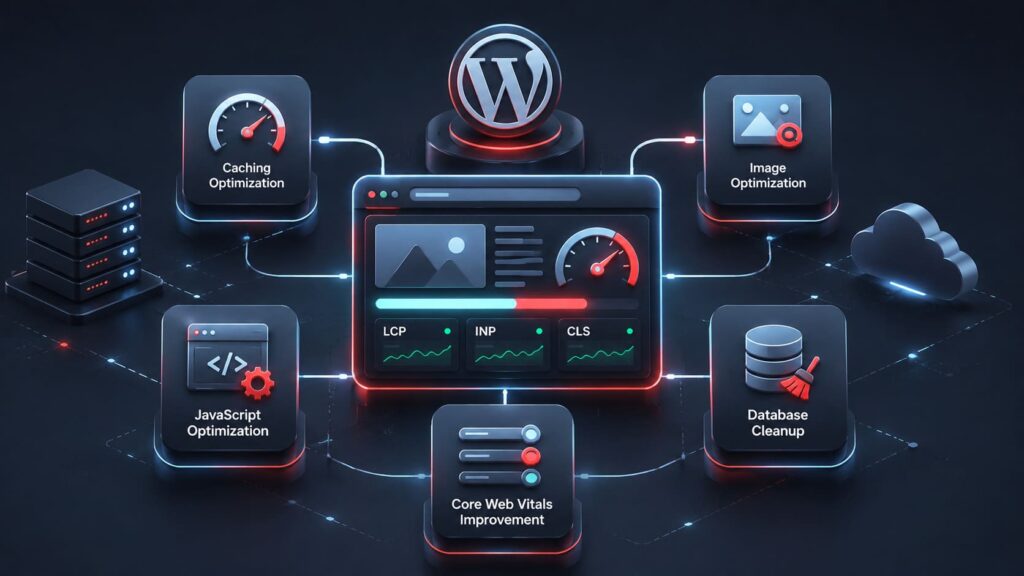
Top 5 WordPress performance plugins: how to improve Core Web Vitals
Looking for the best WordPress performance plugins? Compare the top solutions for caching, JavaScript optimization, image compression, and Core Web Vitals improvements to make your website faster.
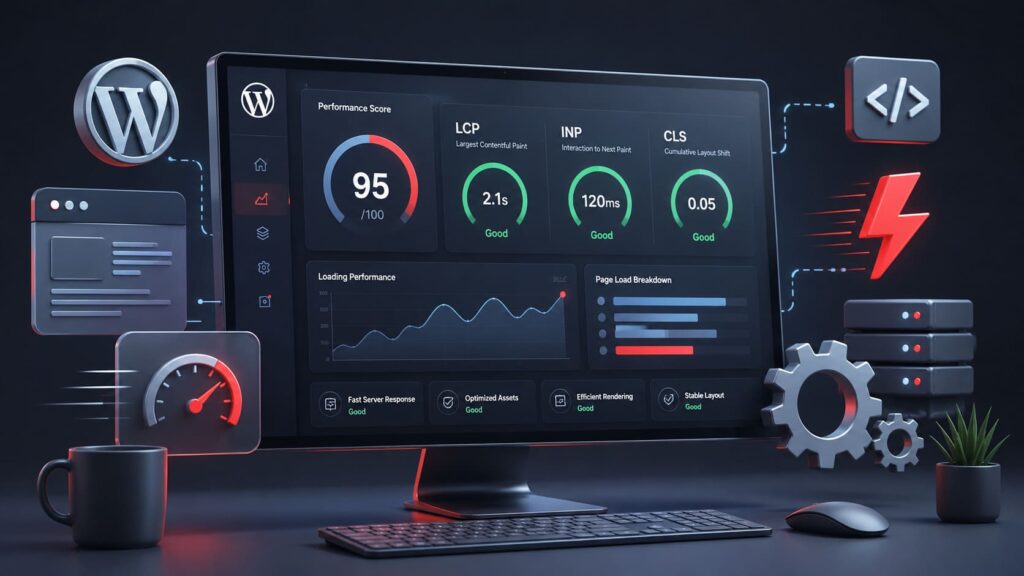
How to Improve Core Web Vitals for a WordPress Website
Improve your WordPress website performance with practical Core Web Vitals optimization techniques. Learn how to fix slow loading, poor LCP, INP, CLS issues, and improve Google PageSpeed scores without relying only on plugins.

Rating Schema: Best Practices for SEO and Structured Data
Rating schema is one of the most valuable types of structured data for websites that collect reviews, ratings, and user feedback. By implementing Schema.org rating markup, website owners can help search engines better understand their content and provide additional context about products, books, software, courses, and other rated entities.

My Honest Take on Elementor: Powerful Builder or Long-Term Trap?
Elementor is one of the most popular WordPress page builders, praised for its flexibility and visual editing. But behind the convenience lie several serious technical drawbacks. In this article, I share both the strengths and the hidden problems of Elementor, from database bloat to scalability and SEO challenges.